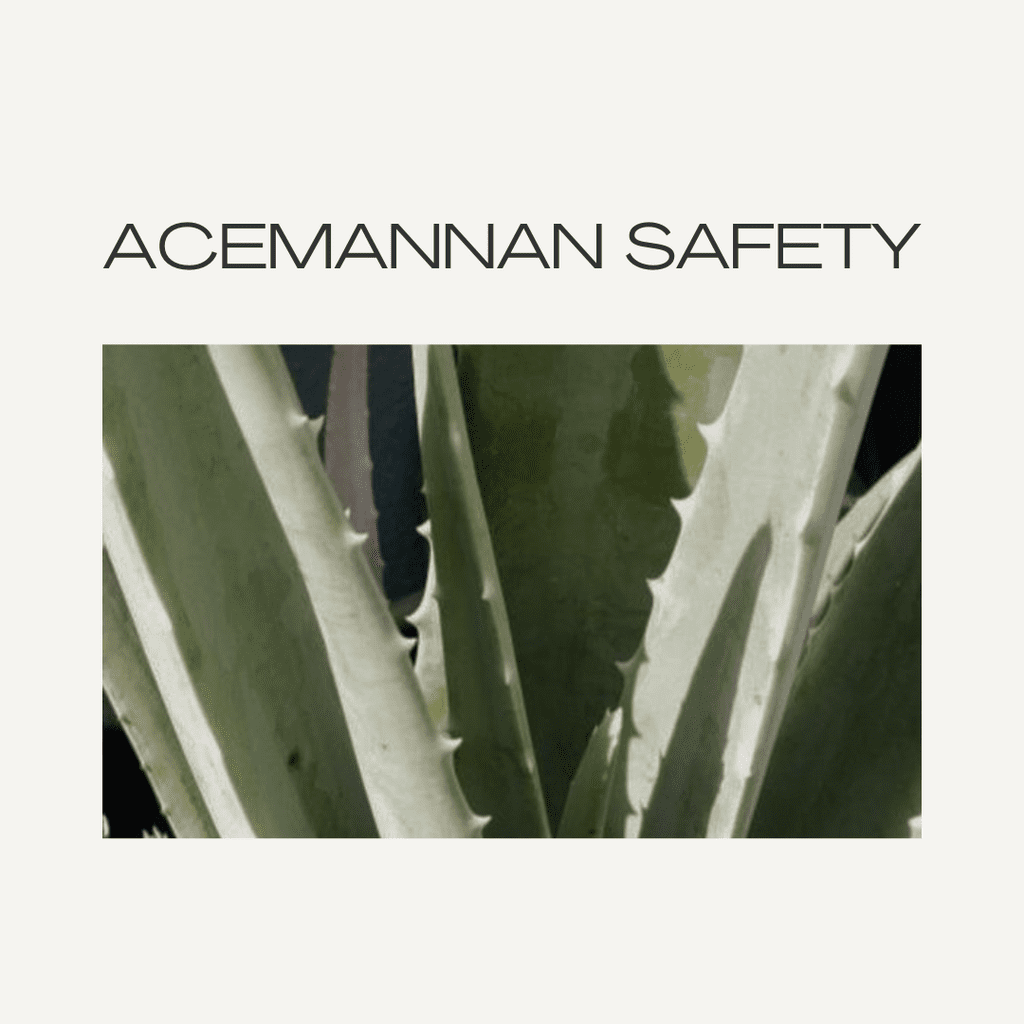
Most of the warnings on Google about “aloe toxicity” come from an entirely different part of the plant than the one used in acemannan research.
People lump everything together as if: aloe gel = aloe latex = whole-leaf aloe = acemannan. They’re nothing alike. This page lays out the actual science that separates:
- Aloe latex (the toxic part)
- Aloe vera gel (inner leaf fillet)
- Acemannan (the purified polysaccharide used in research and in Immun)
Once you see the distinction, the fear-based posts online make a lot more sense.
Aloe Latex: The Part That Is Toxic
Aloe latex is the yellow sap between the inner gel and the rind.
It contains anthraquinones like:
- Aloin
- Aloe emodin
- Emodin
- Hydroxyanthracene derivatives
These compounds behave like stimulant laxatives and are the source of every “aloe is toxic” headline.
𝗪𝗵𝗮𝘁 𝘁𝗵𝗲 𝗥𝗲𝘀𝗲𝗮𝗿𝗰𝗵 𝗦𝗵𝗼𝘄𝘀
NTP Technical Report (Non-Decolorized Whole Leaf Aloe)
This is the study that caused panic online. Rats fed non-decolorized whole-leaf aloe (meaning the latex was intact) developed tumors in the large intestine. The key point most people miss: They did NOT test inner gel. They did NOT test acemannan.
Aloe latex = irritation, diarrhea, electrolyte imbalance, genotoxicity.
Aloe gel = safe.
Toxicity is associated with latex-containing whole leaf extracts, not with aloe vera gel.
Aloe Gel: The Inner Leaf Fillet That Is Safe
When the latex is removed, aloe gel has a completely different safety profile.
It contains:
- Water
- Polysaccharides (acemannan and others)
- Vitamins
- Minerals
- Amino acids
And ZERO anthraquinone when properly processed.
Safety Assessment of High-Purity Inner Leaf Gel (Williams et al., 2010)
This study tested purified inner leaf gel with the latex removed.
Findings:
No toxicity
No mutagenicity
No carcinogenicity
Well tolerated at all tested doses
Decolorized = latex removed
This study directly contradicts the NTP study.
Findings:
- No tumors
- No GI toxicity
- Safe for consumption
Cosmetic Ingredient Review
This report often gets misunderstood, so here’s the clarification.
The CIR panel reviews ingredients used in cosmetics, but their toxicology data does not come from cosmetic creams or lotions. They rely on oral, dermal, and sometimes injectable animal and human toxicology studies to determine safety. In other words, they look at how the compound behaves in the body, not just on the skin.
That’s why this report is one of the primary sources documenting that acemannan-rich inner-leaf gel had no toxic dose identified in oral studies.
The NOEL (No Observed Effect Level) for acemannan-rich gel fractions was: 𝟒.𝟏–𝟒.𝟔 𝙜𝙧𝙖𝙢𝙨 𝙥𝙚𝙧 𝙠𝙜 𝙥𝙚𝙧 𝙙𝙖𝙮 𝙬𝙞𝙩𝙝 𝙣𝙤 𝙖𝙙𝙫𝙚𝙧𝙨𝙚 𝙚𝙛𝙛𝙚𝙘𝙩𝙨.
That is an extremely high amount.
For a 150-pound adult, that would be more than 270 grams a day with no signs of harm.
For perspective, that equals roughly 6,750 Alovea Immun capsules per day.
Toxicology studies use massive doses to test safety, and acemannan stayed non-toxic even at levels no human would ever consume. This stands in full contrast to aloe latex, which shows toxicity at far lower levels because it is chemically and pharmacologically different.
𝗘𝗠𝗔 𝗦𝘂𝗺𝗺𝗮𝗿𝘆: 𝗔𝗹𝗼𝗲 𝗩𝗲𝗿𝗮 𝗚𝗲𝗹
The European Medicines Agency states clearly: Aloe gel = low oral toxicity
Toxicity only occurs when latex is present
Acemannan: The Purified Polysaccharide Used in Research
Acemannan comes only from the inner leaf gel, not the rind, not the latex, and not whole-leaf extracts. Once it’s purified, it becomes a completely different category of aloe with its own safety profile and decades of research.
Acemannan is:
- Purified and stabilized so the molecule stays intact
- Completely latex-free
- Free of anthraquinones like aloin or emodin
- Immune-modulating rather than irritating or overstimulating
- Biocompatible and safe for internal and topical use
- Supported by peer-reviewed research across immunology, gut repair, neuroinflammation, tissue healing, cognition, and inflammatory balance
Modern Acemannan Safety Findings
This review pulls together decades of data showing that acemannan is:
- Highly biocompatible
- Non-toxic in repeated dosing
- Clinically safe in humans and animals
- Stable enough for wound dressings, tissue regeneration, and biomedical use
𝗖𝗜𝗥 𝗦𝗮𝗳𝗲𝘁𝘆 𝗥𝗲𝗽𝗼𝗿𝘁 + 𝗠𝗰𝗔𝗻𝗮𝗹𝗹𝗲𝘆’𝘀 𝗧𝗼𝘅𝗶𝗰𝗼𝗹𝗼𝗴𝘆 𝗪𝗼𝗿𝗸
These findings align:
- No measurable LD50
- No LD100
- No systemic toxicity, even at extremely high doses
- No link to the irritants found in aloe latex
- Safe when injected, implanted, or taken orally
These reports are the foundation of why acemannan sits in its own category, separate from whole-leaf aloe and miles away from latex-containing products.
(Referenced in the CIR report above)
What LD50 + LD100 Actually Mean
Scientists use two measurements to understand toxicity:
𝗟𝗗𝟱𝟬
This means “the lethal dose for 50 percent of test animals.” It’s the amount of a substance that would kill half of the animals in a controlled experiment.
If something has:
- A low LD50 → it’s highly toxic
- A high LD50 → it’s relatively safe
- No measurable LD50 → even extremely high doses don’t reach a toxic threshold
𝗟𝗗𝟭𝟬𝟬
This means “the lethal dose for 100 percent of test animals.” It’s the amount required to kill all animals in the study.
If something has no LD100, it means:
- Researchers could not find an amount high enough to be lethal
- Even massive doses didn’t produce toxicity
- It behaves nothing like substances that contain irritants or poisons
𝗪𝗵𝘆 𝗧𝗵𝗶𝘀 𝗠𝗮𝘁𝘁𝗲𝗿𝘀 𝗳𝗼𝗿 𝗔𝗰𝗲𝗺𝗮𝗻𝗻𝗮𝗻
In multiple toxicology studies on purified acemannan:
- No LD50 was found
- No LD100 was found
Researchers kept increasing the dose and still couldn’t reach toxicity. This is the opposite of aloe latex, which does have known toxic thresholds.
The Patent: “Acemannan Has No Demonstrated Toxicity”
The original acemannan patents include real toxicology data, and it’s one of the clearest places that separates purified inner-leaf acemannan from anything involving aloe latex.
In the patent filings, researchers documented two long-term studies:
- A 91-day oral toxicity study in dogs
- A 180-day oral toxicity study in rats
Both used purified acemannan from the inner leaf gel, not whole-leaf aloe or latex. Even at very high doses, there were no clinical signs of toxicity and no pathological changes.
The inventors note that acemannan showed no demonstrated toxicity, was well tolerated, and behaved as an immune-modulating polysaccharide rather than an irritant.
The patents also outline the purification process that removes the latex completely, which is important because the compounds tied to GI irritation and toxicity (aloin, emodin, other anthraquinones) come from the latex, not the gel.
In short, the patent record confirms what modern reviews continue to show: purified acemannan is biocompatible, non-toxic, and fundamentally different from the aloe latex products that show up in toxicity warnings online.



leave a comment
+ show Comments